

AIDOT Co., Ltd. announced on June 5th that it has been finalized as the lead research and development institution for the "Medical Device Core Technology and Product Development" national project, organized by the Korea Joint Ministry Medical Device R&D Fund.
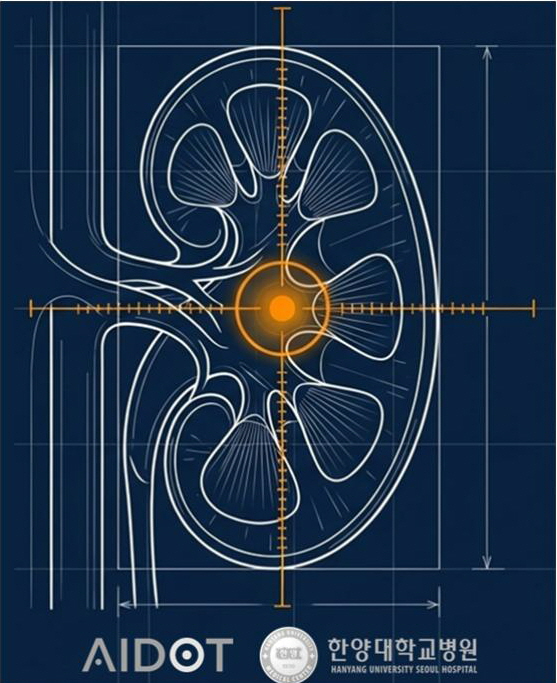
The selected project is titled "Development of Knowledge Transfer and Ultra-Low Latency AI Technology for Ultra-High Performance Closed-Loop Shockwave Lithotripsy," and will be conducted jointly with Professor Young Eun Yoon’s research team from the Department of Urology at Hanyang University Hospital.
The total research period spans 33 months, with an R&D budget of approximately 1.7 billion KRW allocated to the project.
The core of this research and development lies in "Cross-modal knowledge distillation" technology, which transfers high-dimensional stone detection knowledge from 3D Computed Tomography (CT) into a real-time 2D X-ray model, alongside real-time AI technology.
Dr. Hansol Choi, Director of the Research Institute and Principal Investigator overseeing this project, stated that the goal is to enhance the detection rate of X-ray-based stones by utilizing AIDOT's own CT-based stone detection solution, "Urodot AI" (which has obtained Class II approval from the Ministry of Food and Drug Safety), as the "Teacher model."
Through this, they plan to implement dynamic procedural navigation software that segments and predicts the location and contours of renal parenchyma and soft tissues in real time—even in conventional 2D X-ray environments where low contrast limits visual identification.
Furthermore, Dr. Choi emphasized that this project aims to go beyond simple algorithm advancement to innovate actual clinical workflows.
By securing a visual safety margin, the system will segment surrounding organs in real time and mechanically block over-targeting and potential medical accidents. This will minimize unnecessary X-ray exposure, reducing the radiation dose and realizing the ALARA (As Low As Reasonably Achievable) principle for radiation protection.
The project also aims to establish the foundation for a closed-loop system where AI calculates the precise position to control the timing of physical shocks. This will standardize high-precision procedures, ultimately providing an infrastructure that enables primary clinics to perform precision procedures on par with major university hospitals.
Professor Young Eun Yoon of Hanyang University Hospital’s Department of Urology, the co-principal investigator of the project, explained, "During conventional Extracorporeal Shock Wave Lithotripsy (ESWL) in clinical settings, operators faced high fatigue and wide variations in fragmentation rates due to patient stone movement and the overlapping shadows of bones and gas. The AI navigation technology under development will serve as a significant clinical improvement by predicting the 3-dimensional location of surrounding organs on X-rays and calculating the movement path of stones to prevent mis-targeting risks."
Dr. Choi of AIDOT added, "This selection officially validates the technical feasibility of expanding our static diagnostic AI technology into dynamic procedural navigation. Upon completion of the project, we will focus on commercialization and standardization cooperation with global manufacturers to immediately vitalize the SaMD (Software as a Medical Device) ecosystem."
Meanwhile, Dr. Hansol Choi, Director of the Research Institute, holds double majors in Biological Sciences and Computer Science, a Master's degree in Bioinformatics, and a Ph.D. in Neurobiology from KAIST. After working as a researcher at the University of Freiburg in Germany and serving as a professor in the Department of Biomedical Engineering at UNIST, he currently oversees AI technology development at AIDOT.
Korea Economic TV / 2026-06-05 / Deputy Managing Editor Jae-jun Yang


